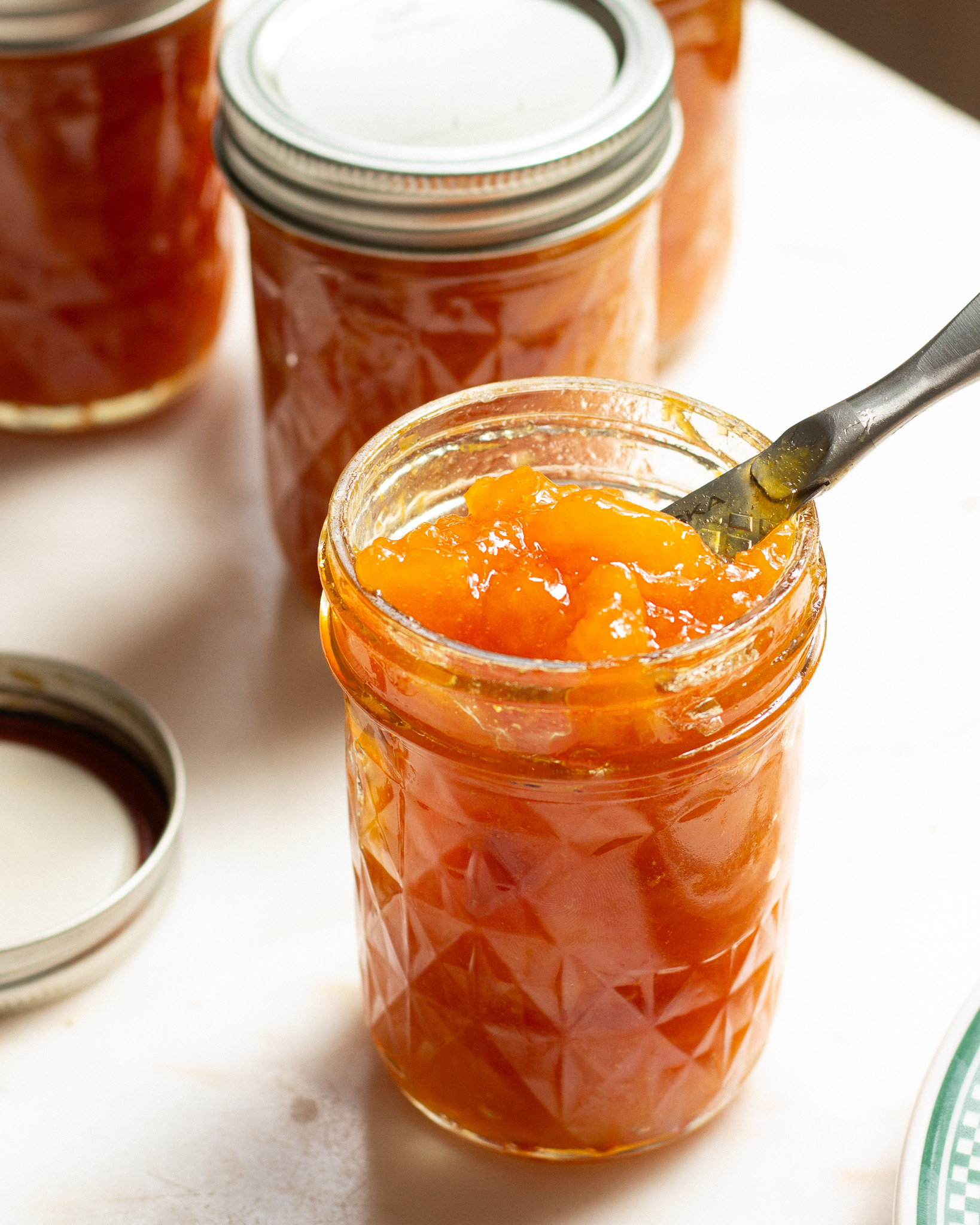
Servings: 8 ounce jars of jam
Equipment
- 1 7-quart Dutch oven or large pot 7-quarts or more
- 1 spatula
- 1 large stock pot 7-quarts or more
- 1 wire rack that fits to the bottom of the stock pot optional
- 6 8-ounce canning jars, or 3 16-ounce canning jars
- 1 pair of tongs or a spider
- mortar and pestle or spice grinder
Ingredients
- 4 pounds yellow peaches, weighed after the pits have been removed
- 21 ounces granulated sugar, 595 grams
- 4 tablespoons freshly squeezed lemon juice
- 2 teaspoons saffron threads
Instructions
- Chop the peaches into bite-sized pieces, each no larger than 1 square inch.
- Add the peaches to a large Dutch oven. Measure in the 21 ounces of sugar and 4 tablespoons of lemon juice. Use a spatula to mix the sugar and fruit together. Let this macerate while you prepare the stock pot.
- Add the wire rack to the bottom of the stock pot and fill it with water.
- Place the Dutch oven on one burner, and the stock pot on the burner beside it.
- Turn the heat under the Dutch oven to medium-high, and let the sugar in the fruit fully melt. Bring the fruit to a low boil, then reduce the heat to medium and begin to cook your jam. The jam will need to cook for at least an hour, but it should be at a simmer the entire time.
- White foam may start to show at the surface of the jam. You can skim this off to maintain the jam's color and clarity, but I never mind it.
- In the first 30 minutes your jam is cooking, "bloom" your saffron. This means add 1 teaspoon of saffron threads to your mortar and pestle and crush it into powder. Add two ice cubes (around 2 tablespoon's worth of water) and crush that into the saffron. It will form into saffron water. Set this aside.
- When the jam has been cooking for 30 minutes, add your canning jars (without their lids) to the stock pot filled with water. Make sure they are completely submerged with no air pockets, and bring that pot of water to a rolling boil. Boil the jars for 15 minutes to sterilize them.
- While the jars are boiling, spread out a clean dish towel on your countertop.
- When the jars have finished boiling, use tongs to remove them from the water and transfer them to the dish towel. I like to "tap" the jars' mouth on the dishtowel to shake off any excess water, then flip them over and let them dry right-side-up.
- After you have transferred the jars out of the stock pot, reduce the heat under the stock pot to low.
- Your jam should be nearly ready by now. You will be able to tell because it will be thick and viscous, and you can swipe your spatula along the bottom of the pot and see a clear line. Add the saffron water to the jam, and sprinkle in the remaining teaspoon of saffron threads. Mix well.
- Increase the heat to medium-high and stir, letting the jam come to 220°F. When the jam has reached that temperature, it is ready to transfer to the jars.
- Fill your jars to nearly full, leaving 1/4-1/2 inch of room at the top. Add the rubber-seal lids. The heat from the jam should act as a vacuum, so only screw on the lid tops until just nearly sealed. Do not tightly seal them.
- Increase the heat under the stock pot to a rolling boil. Submerge your jars upright and make sure at least 2 inches of water covers them. Boil for 15 minutes to process the jars. If you don't have enough space for them to be upright and need to tilt them, just make sure the majority of the headspace of the jar (the part without jam) is still in contact with the lid. This is so the jar can release pressure.
- When the 15 minutes are up, remove the jars and let them cool to room temperature. From there, you can now store in a cool dry place for up to 4-6 months! (See Note).
Notes
Of course, even the best-canned jams can go awry. If you open your jam and see discoloration, mold, or sense a funky, earthy smell, then it is not suitable for eating.
To be extra cautious, you can also store your jams in the fridge.